| MUSEUM
Antique Rosaries |
HISTORY
of the Rosary |
for you index |
cord instructions |
LINKS |
EMAIL
US+
877 695 3561 |


AMBER GALWAY ROSARY |

SILVER GALWAY ROSARY |
|
MUSEUM ROSARIES ARE NOT FOR SALE (for more information, scroll down) + ABOUT GALWAY ROSARIES *HISTORY: OF THE ROSARY* We were unfamiliar with the Galway Rosary so this was a great find for the Rosary Museum. The tubular cross was a total surprise since we had purchased one several years ago for the web site and had no idea of its age, origin or whay there was no loop at the top. we saw the Spanish influence in the corpus design. Now we know. for more information
see
|

*AMBER GALWAY ROSARY* |
|
(dated 18th - 19th Century) +
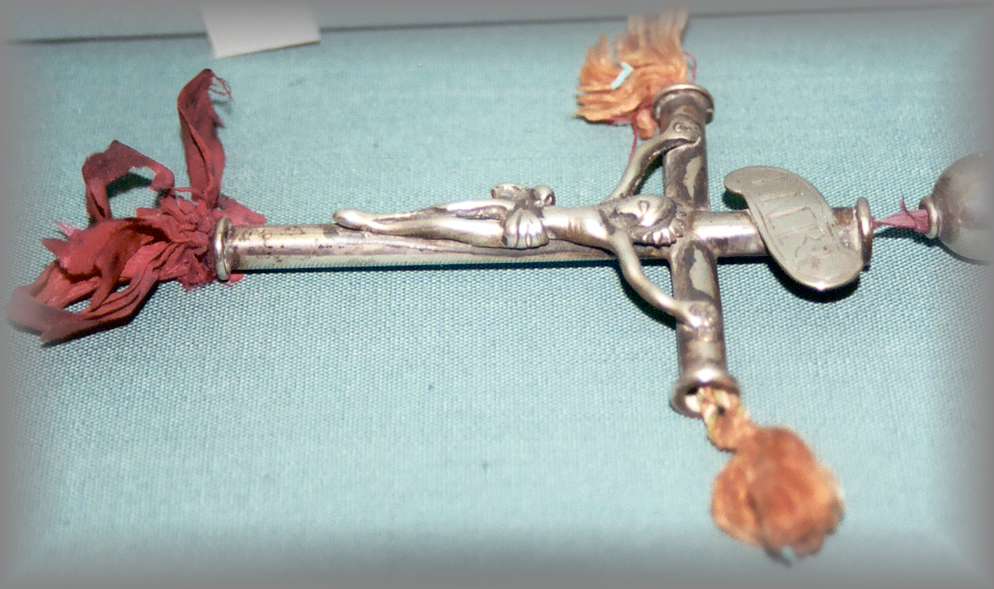
GALWAY CROSS Instead of a ring at the top, this cross is made of 2 hollow tubes. This allows it to be attached to the rosary from either the top or bottom of the crucifix The cord (if strung) is pulled through the length of the tube and beads then looped back through the crucifix either creating a tassel or attaching one to the end.. The chained rosaries are done in a similar way and the samples below appear to use cord or leather thong. +
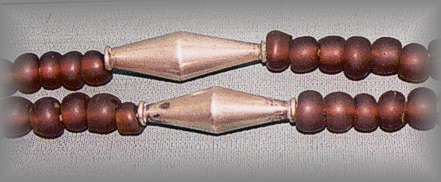
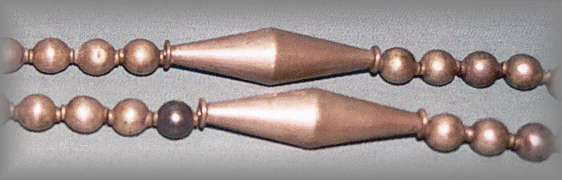
SILVER 'BICONE' PATERS Long silver bicone Pater beads with turned ends appear traditional in Galway Rosaries This one has Ave beads in amber and is dated 18th - 19th Century. Note the red silk fabric, cut into thin strips to form a tassel a the bottom of the crucifix. Arms of cross are finished with small golden silk tassels, all threaded through the hollow tubes of the cross. +
TASSELS AND PASSEMENTERIE Often a bead is attached to the bottom first to hold the tassel in place. The arms of the cross carry a continuation of the design. Tassels were often used for functional and ornamental reasons yet carried the symbolism of 'wiping away the tears'. It is interesting that several of the 'tassels' use techniques found in military uniform passementerie (trim). |
|
*SILVER GALWAY ROSARY* |
|
(dated 1790) +
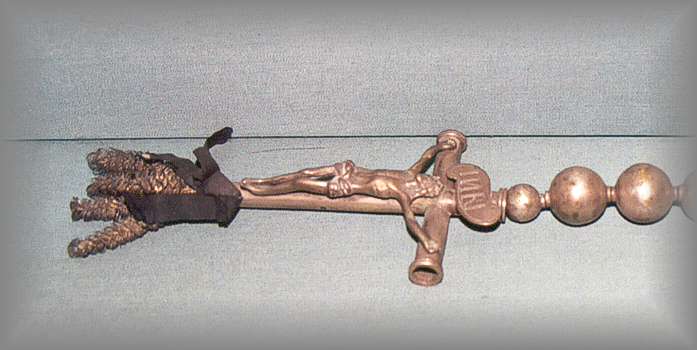
BROWN SILK STRIPS The tassel at the base of this Cross is made from brown silk strips and gold bouillon (Passementerie or trim) often found on large tassels used in architectural appointments of the period including military uniforms and gear. +
HAND FORMED SILVER BEADS Pater beads are called 'bicones' with turned ends - while the Ave beads are round. Note below, the 3 beads in the pendant are much larger than the beads in the loop. Prayers said on these 3 beads are for a deeper sense of Faith, Hope and Love. +
The gold boullion passementerie tassel may have been simply available but since the rosary is often called a 'Weapon Against Evil' , We thought it very appropriate as this trim is used in military uniforms! |
|
*ROSARY DIRECTORY* |
|
see a rare look of the relics of yhe passion of Christ as shown in the church in Rome called HOLY CROSS IN JERUSALEM (SANTA CROCE in GERUSALEMME) The Relics of the crucifixion of Jesus were brought to Rome - from Jerusalem - by St Helena, mother of the first Christian Emperor of Rome in the early part of the 4th Century. By tradition the first building to house the relics of the Passion in Rome was on the property where she lived. The land was packed with earth from Jerusalem which gave it its name |
|
18c Penal Rosaries and crosses, a mini history with pictures. |
|
Rosaries of amber and ivory, from the 1700s - 1800s |
|
An overview of the rosary crosses of Ireland |
|
TO THE HUNT MUSEUM We are grateful to the Hunt for allowing us to share this information with you the students and lovers of the history of the rosary so you may learn more about the precious rosaries of Ireland. + All images are used with the permission of the Hunt Museum, Limerick Ireland. Please contact the Hunt directly for use of or further information regarding this collection. There is much more on their site so you don't want to miss it! + THE HUNT MUSEUM The Custom House Rutland Street, Limerick Ireland Tel 061 452022 |
|
MISSION STATEMENT Our vision is to provide the finest handmade rosaries, chaplets and other fine religious art forms for personal worship we can make using the finest supplies available. The Guild believes the work of our hands should give visual Glory to God, therefore for us, the best for you is very, very important. +++ QUESTIONS? ask us: copy and paste beadsong@hotmail.com OR CALL WEEKDAYS - 9 to 5central 877.695.3561
MUSEUM
- HISTORY
- PRAYER
for more information
see
OFFICE
HOURS
|
|
secure-online - credit card -[or]- mail in - mo/personal check |