| MUSEUM
Antique Rosaries |
HISTORY
of the Rosary |
for you index |
cord instructions |
LINKS |
EMAIL
US+
877.695.3561 |
 |
 |
 |
|
+ DO YOU HAVE INFO TO ADD? The purpose of this little online museum is to share information on the rosary to designers, collectors and students. We delight in the fact that many have responded to our request for images of their personal collections of antique rosaries. Images are sent to be identified and shared. But since we don't always know, we hope you may be able to identify, date - add information of any kind that will be of benefit to those who want to know more about the history of the rosary. take links
to more Filigree Rosaries and a Variety of Chaplets below.
|


*SPAIN / LATIN AMERICA 16 - 17c* |
|
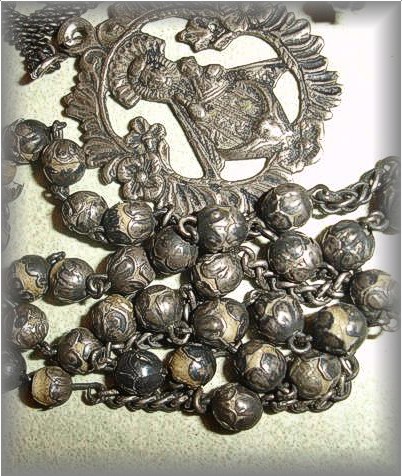
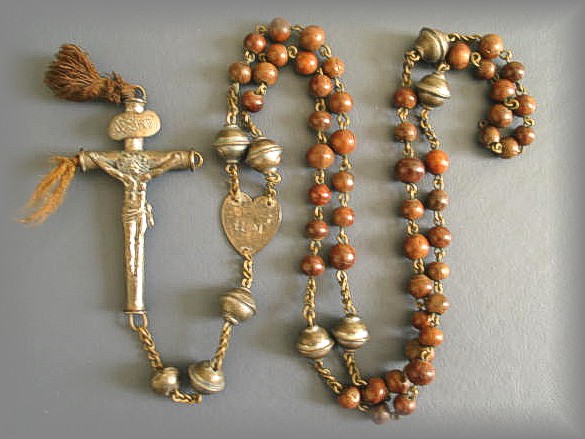
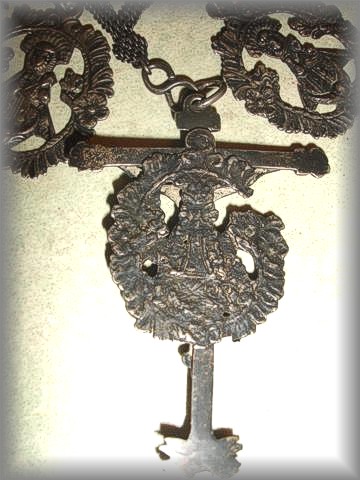
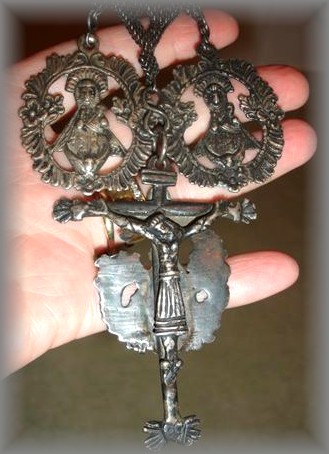
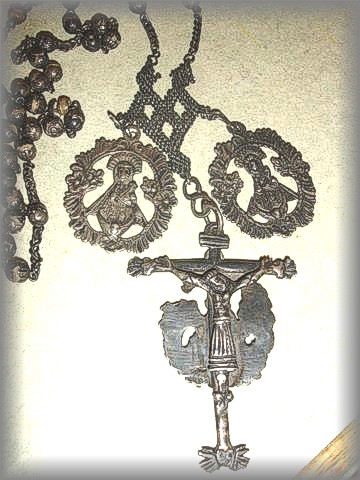
I bought it in a local junk shop in Swansea, s.Wales theUK. I spotted the Rosary in the corner of the display case in the very bottom, it was just by chance as there were so many things alongside and on top of it .It might of been there for years. It was that type of shop. Other than that I am really sorry that I can't tell you more. +
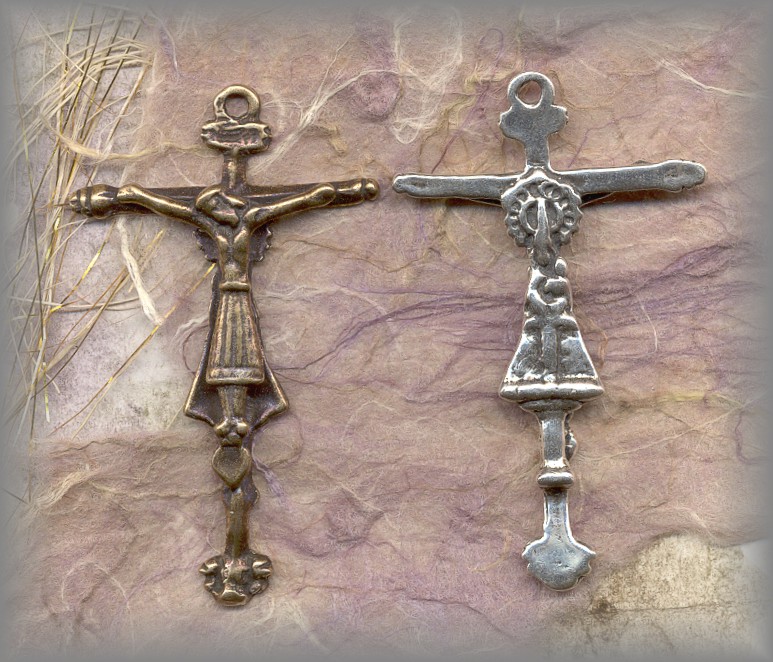
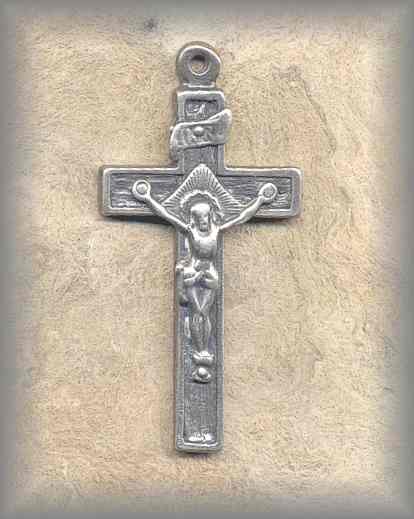
+\ (The crucifix is very similar to our 'Lord of Mircales' crucifix (16 - 17c). Medals also reflect the Spanish Influence found in New Spain (Latin America) during that period.) (see below) + LEFT: Two faced crucifix, traditional for the times CHRIST / MARY
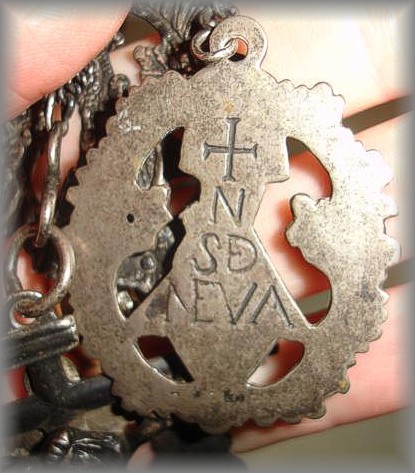
+ "It is quite large ,and well tarnished. Part of the aura around Jesus looks as if it has been worn away in prayer as when I put it round my neck I found myself automatically drawn to the area that is smooth and worn away. It is very tactile and I found myself just rubbing the same area." + Unknown Engraving possibly identifying Our Lady on obverse side?
+ 'N SD NEVA' "The cross itself measures just over 3 inches in length and 2 inches in width, but from the top of the pendant ..... where the meshing is, the length is 5 inches, the two smaller pendants are 1.5 inchs across and are both different in design. One has 'N SD NEVA'written on the back.Would anyone know the relevance of this word.The beads appear to be made of bone." Darran Prosser |
|
Thomas Scott Tucker responds: 'I have some information on the first listed rosary in your section asking readers to help identify rosaries. The rosary is listed (possibly) as a 17 century Spanish rosary. On the back of the center medal an inscription reads “N SD NEVA.” Neva is one form of the word “nieve”, and may be familiar from the name of the state of Nevada. (Spanish for snow fall, snow covered, snow clad) The abbreviation on the medal stands for Nuestra Senora de Neva (put a squiggly tilda over the n in Senora and pronounce it like the n in “new.”) This would be a medal of Our Lady of the Snow. + This Marian devotion is widespread in Italy, Spain, Portugal and Latin America. According to one legend, a wealthy noble couple in Rome had prayed for children but received none, so they prayed instead to use their wealth for a good cause. In one version, she appears in dreams to the couple and also to Pope Liberius (352 – 366), telling all three of them to build a church in a place where she will send a miraculous sign. + At the height of summer, a miraculous snow was said to have snowcapped the Esquiline Hill in Rome, and that is where the Basilica Liberii was built. It was restored and dedicated to Our Lady by Pope Sixtus III. According to an article in the Catholic Encyclopedia online, the legend itself did not arise till several centuries later but became popular and was absorbed into some liturgies. + There is also a legend that travelers in the Sierra Nevada in Spain were rescued from a snowstorm by the guidance of Our Lady of the Snow. For more information the Spanish Wikipedia entry is useful (search using her name in Spanish), and also the Catholic Encyclopedia article in English at this weblink:' www.newadvent.org/cathen/11361c.htm Santa Maria Maggiore + With special thanks to Thomas Scott Tucker from the Rosary Workshop + SIMILAR CRUCIFIX
MAY BE PURCHASED (copy and paste item number in SHOPPING STORE |
|
*IRISH GALWAY ?* |
|
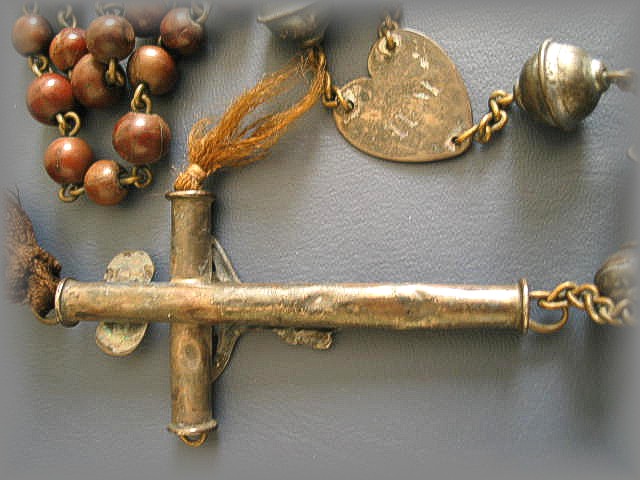
FROM THE OWNER I went to a small auction in up state NY since they had a large grouping of older Native American items and with these items was found this rosary - I purchased the rosary as well as a few of the Indian items. I did some minimal research as I know little about rosaries (raised protestant so not too familiar with the catholic rituals) and came upon your web site and the Galway rosary - a really wonderful web site by the way - which is so similar to what I have that I assumed it was in the same family." +
"The rosary measures 31" from end to end. It appears to have been plated (silver?) as the remaining metal seems more like brass. The patina is wonderful - the beads worn smooth and shiny, the metal worn with only plating left in the crevices. +
The cross hangs upside down and considering the long length, I wonder if it may have been kept by the parish as I think of it hanging around the neck and then held up with the hand to bless others? The length suggest it was worn around the neck and not meant for just the hand thus the upside down cross?" +
HOLDS THIS MUCH ENERGY "I am curious if this "Galway" style means that this rosary was made in Ireland or whether this style was copied in the US? I would also be curious as to guess on age - considering the use and patina I would guess 19c, but I would also imagine the metal used - with its plating - may suggest a more precise age? + I do not collect religious items, as I keep my interest with the Native American Indian material, so I may consider selling or trading this rosary. But I love to find out the most I can about beautiful things such as this - as anything that holds this much energy and human life deserves better understanding (this is also why I collect the Native material - the energy in those pieces can be very strong). Any information would be great. I appreciate your time and knowledge." James Compton |
|
Galway (Irish: Gaillimh) crucifixes seem to carry the Spanish influence and yours seems to have more of the European look than the one we have below but between the two, it gives one the overall feeling of these tubular Galway crosses. I sincerely doubt yours was made in the US as yours carries all the attributes of a 19 c rosary with its wooden Avea and metal Paters. The 'upside down' crucifix with tassels is standard and the heart center was popular through the 1900s. A wonderful piece - I hope someone visiting has more to share. + NOTE SIMILARITY TO CRUCIFIX ABOVE
MAY BE PURCHASED (copy and paste item number in SHOPPING STORE |
|
*JOHN WILLIAM WOLF'S ROSARY* |
|
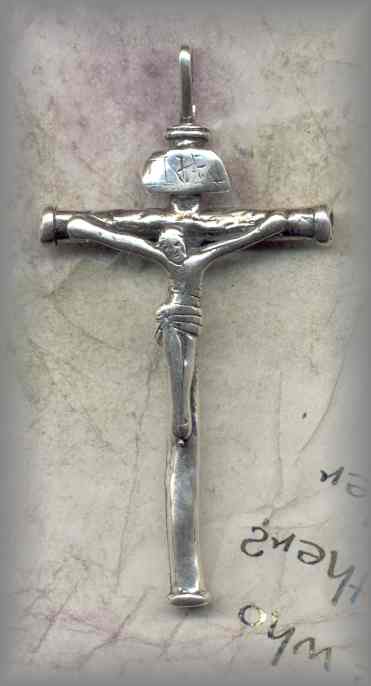
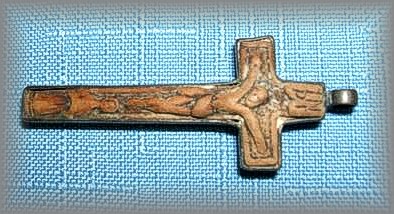
+ HANDCARVED WOOD CRUCIFIX SET IN SILVER closeup of crucifix - 2 in (52mm) 1809 - 1899
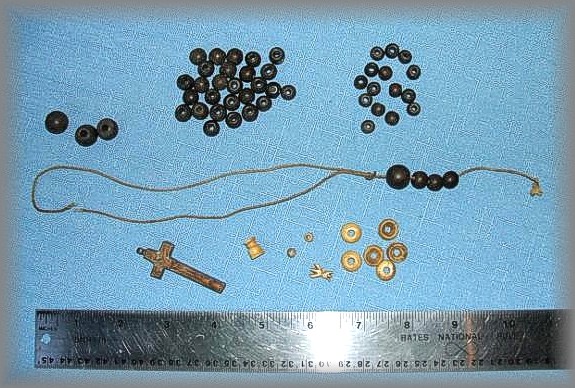
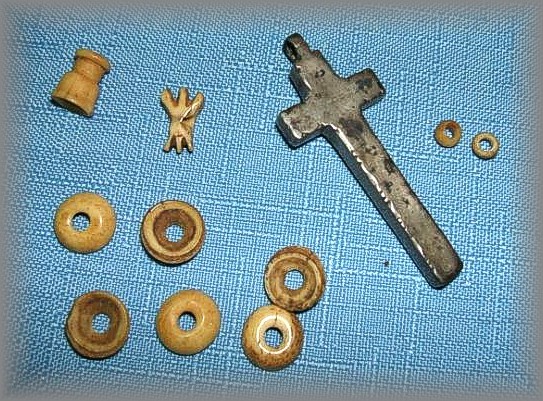
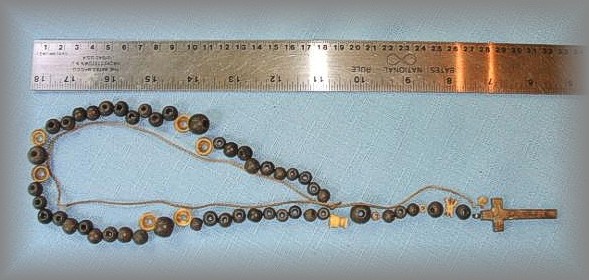
I have been studying your web site and information. Can you help us identify, date, and tell us how to re-string our rosary? My family found this rosary in a basement in an old tobacco sack. The string is broken so it is no longer intact. We don't know if any beads are missing. It came from the estate of our Uncles’ Edward Wolf (Born 1890 - Died 1971) and Lewis Wolf (Born 1894 - Died 1963). We believe that it belonged to their Grandfather John William Wolf, Sr. (Born 1809 - Died about 1899). + beads sorted by size
He worked as a carpenter in the Hohenzollern Castle in Germany. He migrated to the United States late in his life, when his son brought him over. He and his sons were farmers near Kenton, Ohio. We also have his Catholic Bible, written in German. He is the only known Catholic in our family. + possible configuration of original rosary
+ The wooden beads appear to be hand turned and the sizes of them are variable. The cross is well worn, hand-carved in wood and backed with silver. The yellowed creamy colored beads may be made of bone, antler or ivory? The size of beads are given in "WolfRosaryPiecesMeasured. If you could help us help identify, date, and figure out how to put it back together we would appreciate it. Thank you, Norma Dudiak |
|
This is a wonderful rosary and carries all the attributes of being home made for personal prayer. I believe you have dated it very well through the enclosed history. The crucifix is interesting. It has a sense of the Irish Penal with its short cross arms. Yet the wood carving is set in a metal frame like the German crucifixes we see used and crafted by religious for use on rosaries. The little 'tooth' like carving is found on old rosaries of this period along with the pierced extremities of the crucified Christ including - 2 hands, 2 feet and often skulls. Does any one know what the little tooth like carving symbolizes? Also see the little chalice like cup to capture the lifeblood of Christ. It appears that the image of Mary is carved at the feet of Christ on the Crucifix. We visited the Hohenzollern Castle in Germany where he worked - truly magnificent! + NOTE SIMILARITY TO CRUCIFIX ABOVE
MAY BE PURCHASED (copy and paste item number in SHOPPING STORE |
|
*WHAT IS THIS ?* |
|
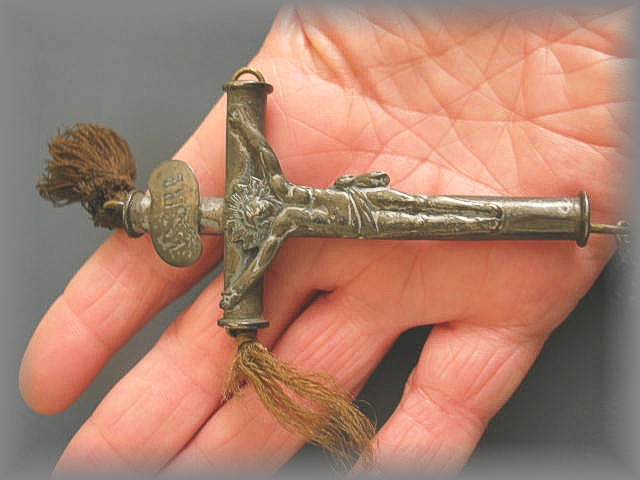
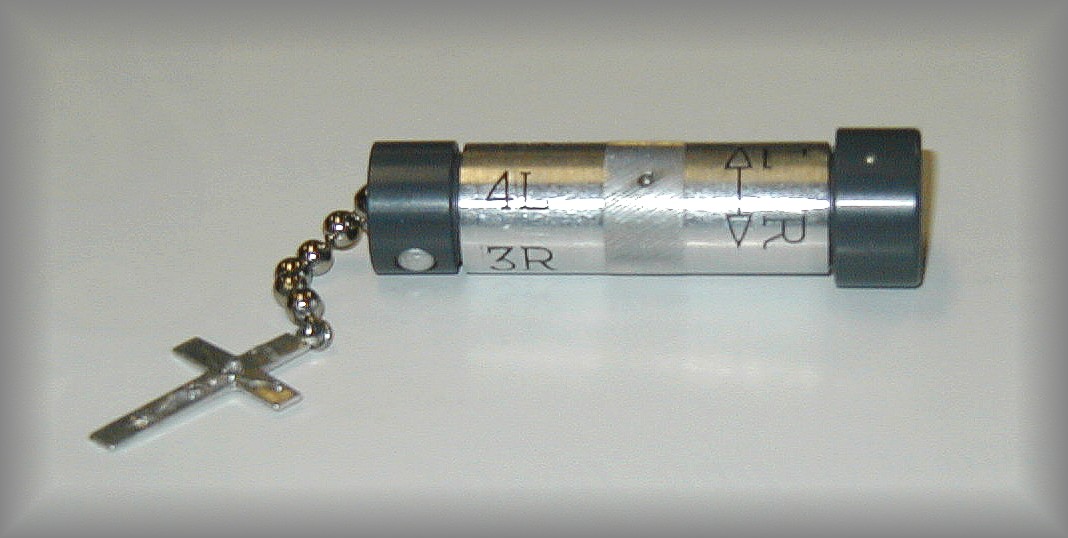
Someone gave me an item which seems to have everyone stumped as to its purpose and operation. It is described as a metal cross embedded with an image of Jesus. It is attached to a metal cylinder by a small metal chain (beads). The cylinder is embedded with the following on the left side(nearest to the chain attaching the end of the cylinder to the cross): 5R,4L,3R,2L,,1R, On the right hand end of the cylinder are two arrows pointed in opposite directions indicating L (left) ? R (right).... +
.... The two ends of the cylinder rotate in opposite directions by twisting them. Everyone from the Rector at The Cathedral to every Catholic person who I have asked is stumped by this object. Would be overjoyed if you could solve this mystery. The cylinder is finely machined, so this was made with something in mind! Nothing inside at all. The cylinder is about 2 1/2 inches long, and bare of any trademarks,etc. James Bell |
|
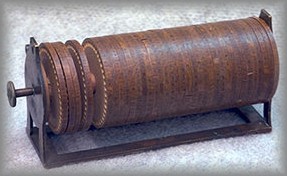
CYPHER WHEEL? A KRYPTEX? We are totally baffled! Thomas Jefferson devised an encoder and decoder of messages during the American Revolution (Cypher Wheel of wooded discs (below) and theory was used from 1795 - 1942 (M-94) The internet has some great games for kids under the Cypher Wheel. + JEFFERSON'S DISC CYPHER
+ Something like a bicycle combination lock, but do not see a relationship here. The word Kryptex or Cryptex brings up interesting images (including the Da Vinci Code). + SOME DO OPEN Another wrote in re the cypher wheel: they do open; but only if you know the "combination" they where used to send messages you wanted seen only by recipient; if forced a vile of vinegar was broken and the message written on delicate parchment destroyed. + SOMEONE KNEW THE MYSTERY Does anyone have any thoughts on this? One of a kind? Suspect if used as a prayer counter, it was designed and made by someone who knew its mystery! Was it designed to open up - or just count? Read what Noel Duncan wrote below: |
|
Howdy! Interestingly enough the sum of the numbers in the sequence 5, 4, 3, 2, 1, is fifteen (15), suggesting a 15 decade rosary. If there were ten beads holding the cross to the device then those beads could represent the mater [Ave} beads. + THIS NOW SUGGESTS A POSSIBLE METHOD: Finding an index point -- the image on the website suggests two possibilities -- and setting, for instance 5R, at the index point and then praying ten beads would complete one decade. + Now pray one "Our Father" and rotate the "right end of the column one click (major assumption here) to the R[ight] (?) and repray the "Hail Marys". Repeat. + It's possible that a ratcheting mechanism performs a decrementing (or incrementing) movement on the numbered side of the device. + Any way, the upshot of the foregoing seems to imply that the device is a counting device, albeit a clever implementation of one, for a possible single decade rosary which enables one to pray a fifteen decade rosary and nothing more. Cheers, Noel Duncan (Houston, TX) |
|
*RARE FLAT ROSARY WHEEL* |
|
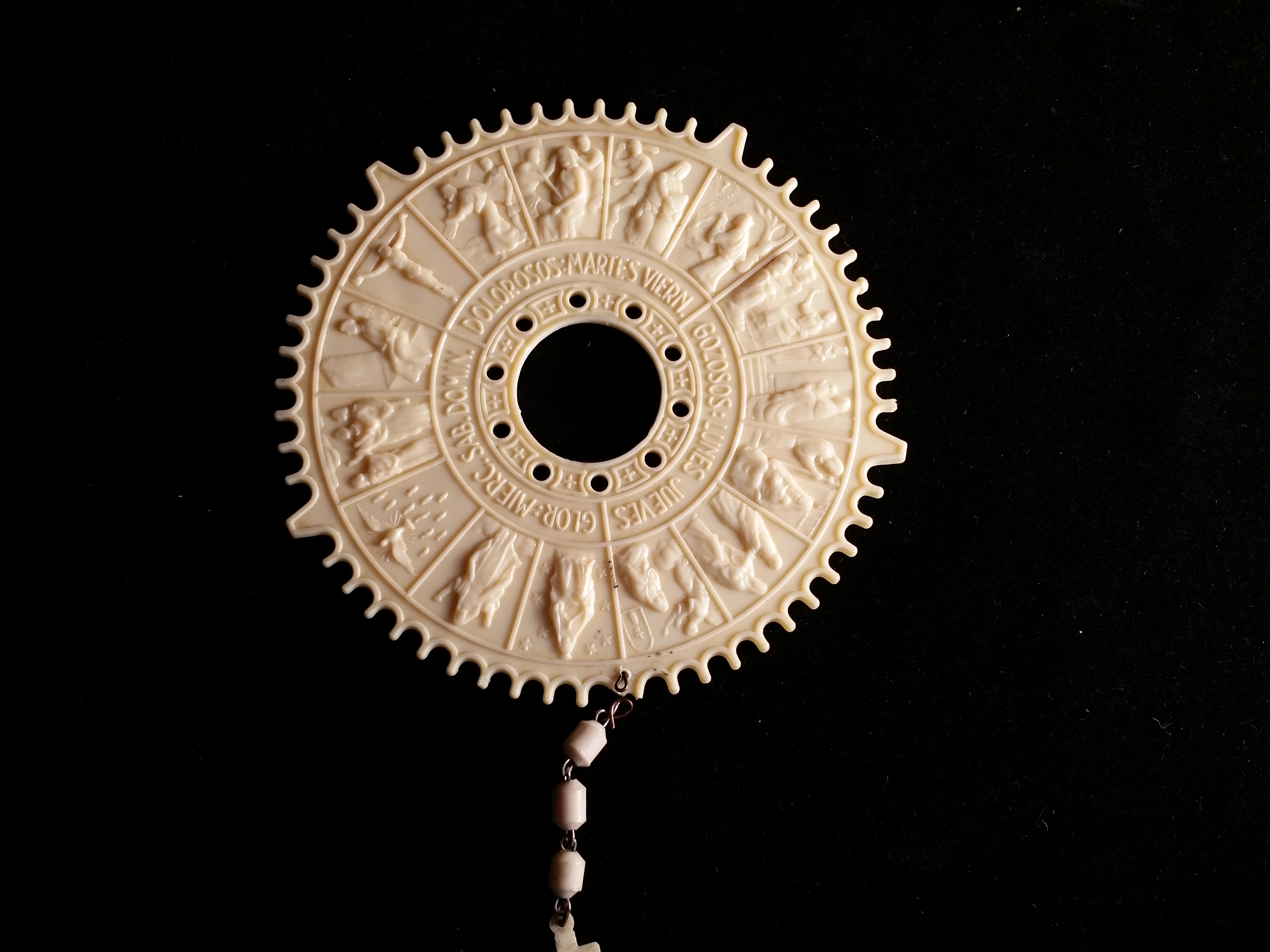
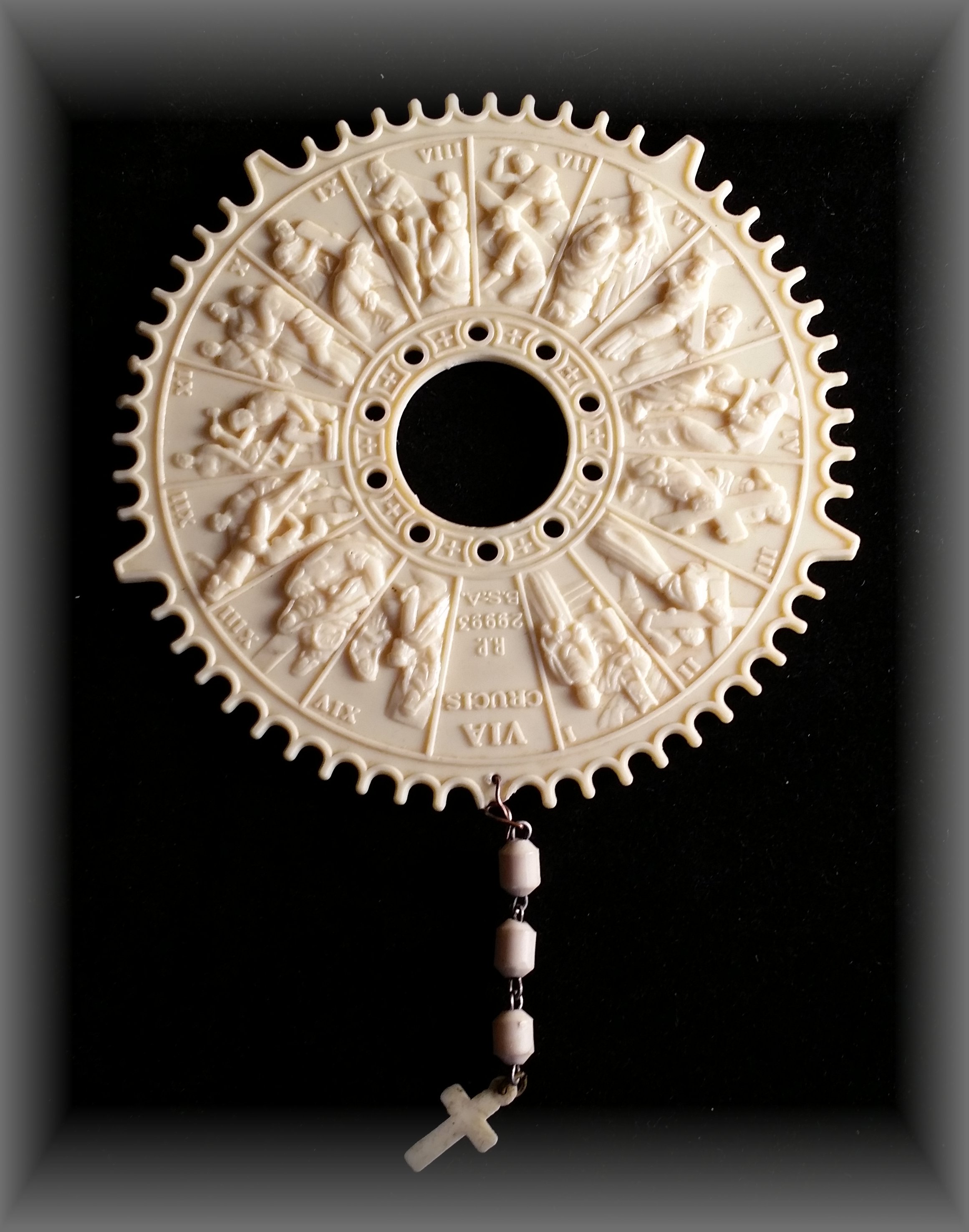
Rosary with glorious joyful mysteries and RP 29993
+ VIA CRUCIS (way of the cross - stations of the cross)
+ (Plastic. Measures 8.5 cm diameter. Total measures 10.5 cm diameter.) |
|
Hi, I hope someone
can help me identify this. I recently bought a rosary wheel on ebay
from a seller in Buenos Ares, Argentina. The seller had no information
about it at all.
There is a mark : "R.P.
29993, B.S.-A."
I have not been able to find any information about this piece or even anything similar. I can guess that it is early 20th century, but what is its story? Is it a modern copy of an older style? Was its use common? Are there more out there to be found? Thank you for any information you can give me, Lillian Nobles |
|
*SENDING YOUR IMAGES*
.. SENDING YOUR IMAGES FOR CONSIDERATION ... |
|
Since this is an open museum for antique and vintage rosaries, we encourage you to send your images for consideration with the following in mind: CLEAR IMAGES (a must) - UNUSUAL CONFIGURATIONS AND MATERIALS USED + ANY INFORMATION YOU HAVE IS IMPORTANT If known, please include AGE - ORIGIN - SIZE If you don't know, possibly you have information on its owner, age or history. Please include anything you feel will identify your rosary or chaplet such as prayers, name of chaplets if known. Remember, the purpose of this site is for the student of the rosary - for those interested in the history of the rosary and how it has been used over the centuries. + WE MAY BE ABLE TO HELP So if you have no information, please do not let that stop you from sending it in. And if we cant help, we will ask for others to add their comments. + WELCOMING YOUR COMMENTS You may see rosaries and chaplets in our museum that you know something about, if so, please share - many have and it has become a wonderful resource for those who want to learn about the rosary and its history. + SEND ATTACHMENTS AND INFORMATION TO: Please identify your email ROSARY MUSEUM so it is not deleted by mistake. Mail information and images to: |
|
1st CLASS Part of a Saints body (bone, hair, etc.) and the instruments of Christ's passion 2nd CLASS
3rd CLASS
|
|
*VISITOR COMMENTS* |
|
De Colores: Thank you for the information/research on the History of the Rosary. I have been asked to make a presentation on the Holy Rosary to my fellow paritioners Cursllistas de Christiandad and you info is great. I'll be back for additional information. My prayers and appreciation. Joe Noriega |
|
MISSION STATEMENT Our vision is to provide the finest handmade rosaries, chaplets and other fine religious art forms for personal worship we can make using the finest supplies available. The Guild believes the work of our hands should give visual Glory to God, therefore for us, the best for you is very, very important. +++ QUESTIONS? copy and paste beadsong@hotmail.com OR CALL WEEKDAYS - 9 to 5central 877.695.3561
MUSEUM
- HISTORY
- PRAYER
OFFICE
HOURS
|
|
secure-online - credit card -[or]- mail in - mo/personal check |