| MUSEUM
Antique Rosaries |
HISTORY
of the Rosary |
index |
cord instructions |
LINKS |
877 695 3561 |
|
Cuauhtlatoatzin - 'Singing Eagle' 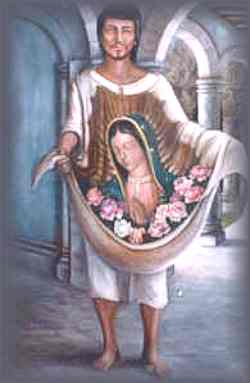
born 1474 - died May 30, 1548 at 74 years |


*SAINT JUAN DIEGO* |
|
A model of Humility BORN IN 1474
“Juanito,
Juan Dieguito “, “the most humble of my sons”,
It was December
9th, only 10 years after Cortez conquered the Aztec Nation. He was on his
way to attend catechism classes and he heard the beautiful singing of birds
when she spoke to him on the hill called Tepeyac. She asked him to tell
Bishop Friar Juan de Zum?rraga she wanted a temple to be built on this
spot. He was obedient but the Bishop did not believe him. Juan decided
to give up on this but she repeated her request. Again he spoke to the
Bishop but was not believed. Finally, the Bishop, sensitive to his sincere
request and obedience, *asked for a sign of this visitation. He also
had his servants follow Juan home but they lost him on the way. The
Virgin again spoke to Juan telling him that she would give him proof the
following day.
|
|
*AN IMAGE of JUAN DIEGO?* |
|
+ VIRGIN OF GUADALUPE'S EYES TELL OF MYSTERY IBM Expert Talks of Microscopic Images Imprinted on Tilma + MADRID, Spain, JULY 17, 2002 (Zenit.org).- In 1929, a microscopic figure was discovered in the eyes of the image of the Virgin of Guadalupe. Since then, the mystery of her pupils has challenged science. One of the men who have expended the most energy in trying to cast light on this image is Peruvian scientist Jos? Aste Tonsmann, an expert at International Business Machines in the digital processing of images. Twenty-two years ago, Aste decided to investigate the presence of other figures reflected in the Virgin's eyes and, in fact, found 12. + On July 31, John Paul II will canonize Indian Juan Diego, the witness of the Guadalupe apparitions, in Mexico. When the human eye focuses, the objects it is looking at are reflected in its retina. "Right now I am reflected in your eye," Aste explained to an interviewer. "According to whether the object is close or far, it will be reflected in a larger or smaller size in the ocular globe," he said. "And this is what happens with the eyes of the Virgin of Guadalupe. The image reflected in her two retinas is that of the moment when the Virgin left her imprint on Juan Diego's tilma." Q: Can these figures be the work of humans? Aste: No, for three reasons. In the first place, they are not visible to the human eye, except for one: that of the Spaniard, which is the largest. Nobody could have painted such tiny silhouettes. In the second place, the origin of the pigments of these figures is unknown. The same is true of the Virgin's image. It is not painted, and no one yet knows how it was stamped on Juan Diego's tilma. Q: And the third? Aste: The three figures are reproduced in both eyes. What artist would do that? Moreover, their size varies from one eye to the other, according to how close the personage was to the Virgin's left or right eye. Q: What process did you follow in your experiment? Aste: First photographs are taken of the eyes. Then they are digitalized. They are read by the computer, enlarged and screened from the images. Q: Who appears in the eyes? Aste: There is a virtually naked servant; an elderly man -- Bishop Friar Juan de Zum?rraga; a youth -- the interpreter; an Indian with a tilma -- Juan Diego; a black woman -- a slave; a bearded Spaniard; and, lastly, an Indian family including father, mother, three children and two more adults, who could be grandparents or uncles. Q: How do you know
that
Aste: There is evidence in history. The elderly man who appears in the Virgin's eyes looks very much like the paintings of that period of Bishop Zum?rraga. As to the black slave, Zum?rraga said in his will that he released her. We also know that she was called Maria. In the Indies Archives there is a record of the bishop's embarkation when he left for the New World. ZE02071702
|
|
*WHAT is SAINTHOOD?* |
|
Sainthood is given to those in the Catholic Christian family who have shown heroic virtue. Their lives are honored to encourage and inspire us as we are all called to imitate God's love for us. Since they are members of the Communion of Saints, we are also called to ask them for intercession. We are not called to imitate them as much as to see how they have become who God called them to be in fullness in their practice of the heroic virtues. Charity is at the top of the list. Prudence, Justice and Fortitude, Temperance follow. We are called - "Thou shalt love thy neighbor as thyself. There is no other commandment greater than these" (Mark 12:31). For more information see: HEROIC VIRTUE |
|
Pope John Paul II praised Juan Diego for his simple faith nourished by catechesis and pictured him (who said to the Blessed Virgin Mary: “I am a nobody, I am a small rope, a tiny ladder, the tail end, a leaf”) as a model of humility for all of us. Also see: BEAUTIFICATION AND CANONIZATION In April of 1990
Juan Diego was declared Blessed by Pope John Paul II at the Vatican. The
following month, in the Basilica of Our Lady of Guadalupe in Mexico City,
during his 2nd visit to the shrine, John Paul II performed the beatification
ceremony.
|
|
QUESTIONS? copy and paste now beadsong@hotmail.com OR CALL WEEKDAYS - 9 to 5central 877.695.3561
MUSEUM
- HISTORY
- PRAYER
To visit page
1,2 & 4 use links below:
OFFICE
HOURS
|
|
secure-online - credit card -[or]- mail in - mo/personal check |