~ ARTICLE ~
At the outset,
it is important to note that the early Christians used various means of
counting prayers. St. Paul of Thebes, for example, used to have a bag with
three hundred pebbles and placed one pebble for each of the prayers he
said into another, empty bag. This was also how the sister of St. Francis
of Assisi, St. Clare, prayed.
+
In Christian
Ethiopia prayer sticks were devised and notches were made on staffs used
as supports for people standing during the long services. Forty-one notches
were made since the prayer, "Lord have mercy" is repeated forty-one times
in honour of the forty-one lashes the Coptic tradition believes Christ
received during His Passion. Elsewhere, pieces of wood were attached to
strings and then knotted cords were devised.
+
It was the Western,
Celtic and Sarum Rites that were to develop what is today known as the
" Rosary" or " garland of roses." The Western Churches, like those of the
East, had a great devotion to the Psalter of David which they divided into
three parts composed of fifty psalms each. The " three fifties" were recited
for the dead and for all manner of other intentions as well by both monastics
and lay-people. There were even prescribed numbers of times that the Psalter
was to be recited. For example, for a deceased bishop in England, the Psalter
was to be said by monks no less than 600 times! When a lay-person died,
the Psalter was said over the body immediately and then individuals would
take turns reciting it a further four times throughout the night. St. Patrick
and other Celtic Saints would recite the first "fifty" and then stand in
cold water to recite the next - this to keep alert and awake.
+
To accommodate
monks and lay-people who could not read, little psalters were devised based
on the repetition of the Lord's Prayer and the Angelical Salutation 150
times, divided into three fifties. Other psalters based on meditations
on the life of Christ and the Most Holy Mother of God were also developed.
Soon these were all fused into "Our Lady's Psalter" or the "Rosary," where
15 Our Fathers and 150 Hail Marys were prayed along with meditation on
Gospel themes. The use of the Rosary is of a venerable age and the Western
Rites of the Orthodox Church continue in its use. It was and continues
to be in use among the Eastern Catholic Churches, although its adoption
has sometimes been called a result of "Latinization."
+
The fact of
the matter is, however, that the Eastern Orthodox Church has and still
does use similar prayer forms which are always private practices of the
faithful and never public services as they are in the Roman Catholic West.
+
Orthodox monastic
manuals prescribe the recitation of up to 150 Our Fathers and the same
number of Hail Marys, accompanied by prostrations at the end of each prayer.
The famous Saint Seraphim of Sarov had his special devotion of walking
around the perimeter of the Monastery of Diveyevo, reciting the 150 Our
Fathers and 150 Hail Marys for all one's relatives and acquaintainces,
living and dead. At the end, the person was to ask for one special grace-
and it would be granted on condition that the person truly needed it.
+
The use of a
form of the Roman Catholic Rosary was in vogue among Eastern Orthodox bishops,
including meditation on the mysteries. Such forms of prayer are to be found
among the devotions of representatives of the Kyivan Baroque spiritual
period in the eighteenth century, including St. Dimitry Tuptalo who translated
the "Lives of Saints" into contemporary language and who even adopted western
prayer forms in honour of the "Joys and Sorrows of Our Lady" and the practice
of reciting a "Hail Mary" at the beginning of each and every hour of the
day.
+
Thus, the Western
Rosary was used solely as a substitute for the Psalter which it reflected
in nature. The Eastern "chotki" or "vervitsa" was for a different purpose
altogether.
+
Monks in the
Coptic and Palestinian deserts developed intense, personal prayer lives
where they repeated short prayers to God throughout the day, in response
to the Gospel injunction to " pray always." Soon, a prayer developed that
invoked the Name of the Lord Jesus and united it with a petition for mercy-
"Lord Jesus Christ, Son of God, have mercy on me, a sinner." Forms of this
prayer were used by monks to develop the Prayer of the Heart, constant
spiritual watchfulness and to implore the anointing of the Holy Spirit
as a healing balm over the human spirit and soul, weakened and darkened
by the Sin of Adam.
+
Prayer ropes
consisting of 100 to 300 knots or beads were employed to keep track of
one's counting, since it was believed that this prayer must cleave to the
lips, heart and mind of people through constant, incessant repetition.
Monks often recited the prayer up to 12,000 times per day, until the prayer
became "self-active" and they would pray it day and night. The famous book,
"Way of the Pilgrim" is a good introduction to this form of prayer, along
with the Philokalia, a collection of Patristic wisdom about the spiritual
life and the Jesus Prayer. Greek monks often made what they call, " martyria",
or leather strings attached to the prayer rope with moveable beads to keep
track of the hundreds of times the prayer is recited.
+
Again, the Psalter
as a model for prayer was reflected in the structure of the Prayer of Jesus.
The Fathers of the Church, especially in Jerusalem, divided the Psalter
into twenty "kathismata" each containing three shorter units ended with
the longer doxology: Glory be to the Father . . . Alleluia, Alleluia, Alleluia,
Glory to you, O God (3 times), Lord have mercy (3 times) and Glory be to
the Father.... The Jesus Prayer could substitute the Psalter by saying
300 prayers for each kathisma. Similarly, the Jesus Prayer could substitute
for the Chasoslov by reciting it up to 1,000 times with prostrations.
+
In addition
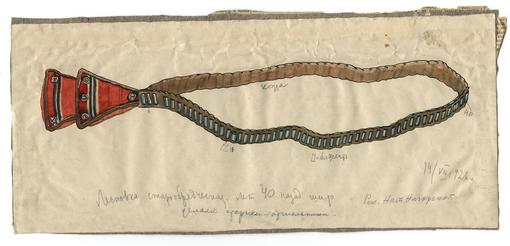
to the woollen prayer rope or "chotki" the Slavs devised a leather prayer
counter with steps or ladders which was called the "vervitsa" or "step-ladder"
(to heaven). To this day, monks of the East are given the chotki or vervitsa
during their monastic profession. They and Eastern nuns where them on their
left hand as a reminder to "pray always." It is from this device that the
later Roman Catholic Rosary was developed. Larger knots separate the smaller
ones on the Eastern vervitsa every twenty-five or ten knots. When it is
separated every ten knots, this is to indicate a prostration to the ground
every ten prayers. Arab Orthodox and Eastern Catholics use prayer beads
divided every 33 beads. This device is also used by Muslims, and evidence
is strong that the Muslims took this from the Christians, and not the other
way around.
+
The use of the
vervitsa in reciting the Jesus Prayer and other prayers is a tremendous
spiritual help to all Christians. It allows one to maintain concentration
and recollection during prayer time. Repeating the same prayer over and
over is not tedious, if we remember that the words of the Jesus Prayer
are like a deep stream of cold, refreshing spiritual water. We need to
drink many times from it to quench our spi ritual thirst and to develop
into spiritually strong persons, until, as our Saviour said to the Samaritan
Woman at the well, "Springs of water will flow within you."
+
Let us use the
vervitsa to frequently invoke the Name of Jesus, the "Epiclesis of our
Lord," as the Fathers call it, to call down the Holy Oil of Divine Mercy
on our hearts and souls, that Oil that heals our inner person and transforms
us. This is a devotion that will last our entire lives, an undertaking
that we do in imitation of the ten wise virgins, who came to their Master
with abundant oil in their lamps. Let us pray that we become like those
lamps, alight with the fire of the Holy Spirit and strengthened in the
Name of our Lord, to perform good works all our lives, so that those seeing
our light and our works, will turn to praise God our Father in Heaven.
As St. Seraphim once said, "Acquire the spirit of peace, and a thousand
souls will be converted around you!" May we all become such missionaries!
|