| MUSEUM
Antique Rosaries |
HISTORY
of the Rosary |
for you index |
cord instructions |
LINKS |
EMAIL
US+
877 695 3561 |

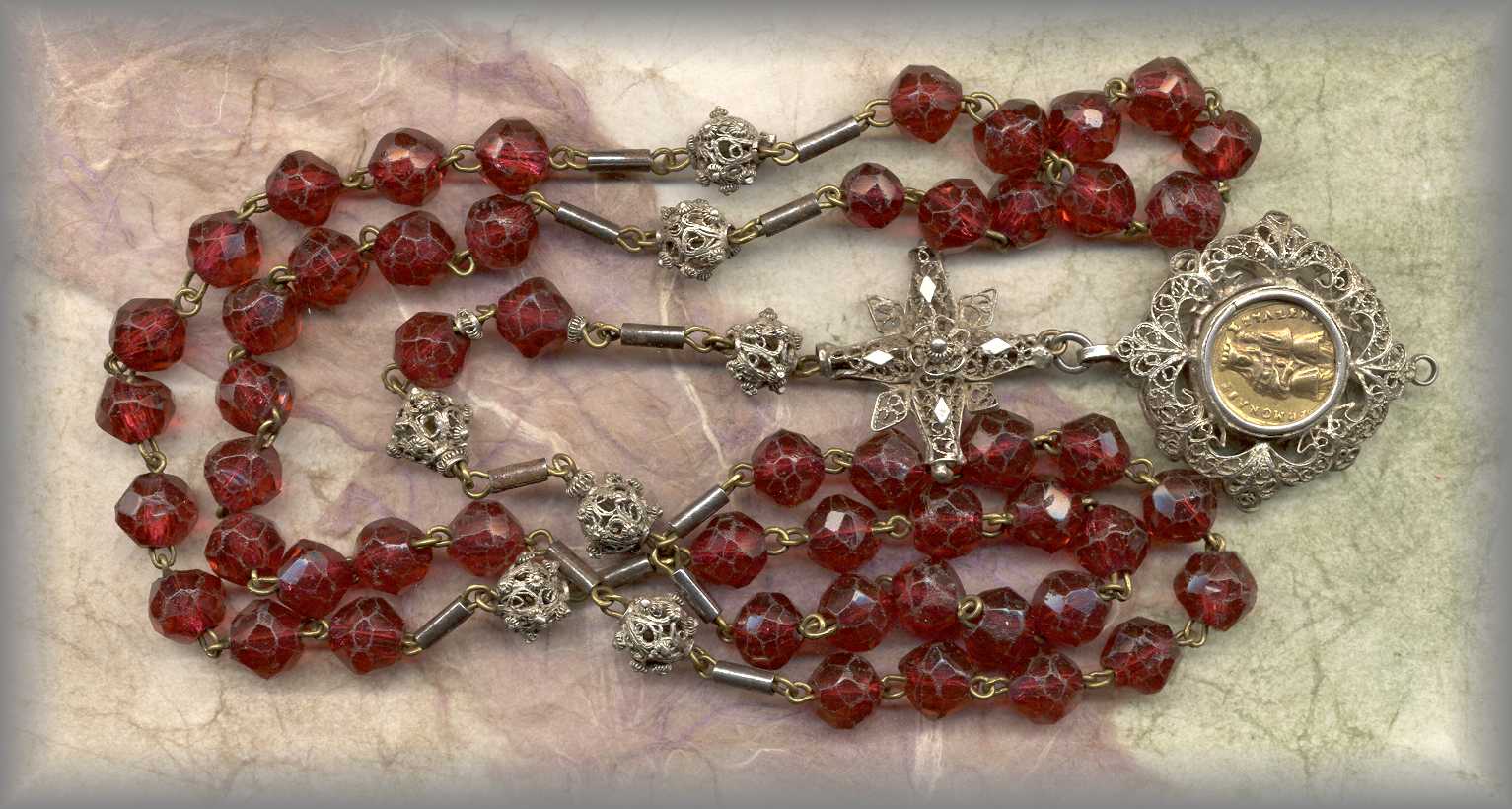
15 in long/7mm garnet beads Dated 1850s |
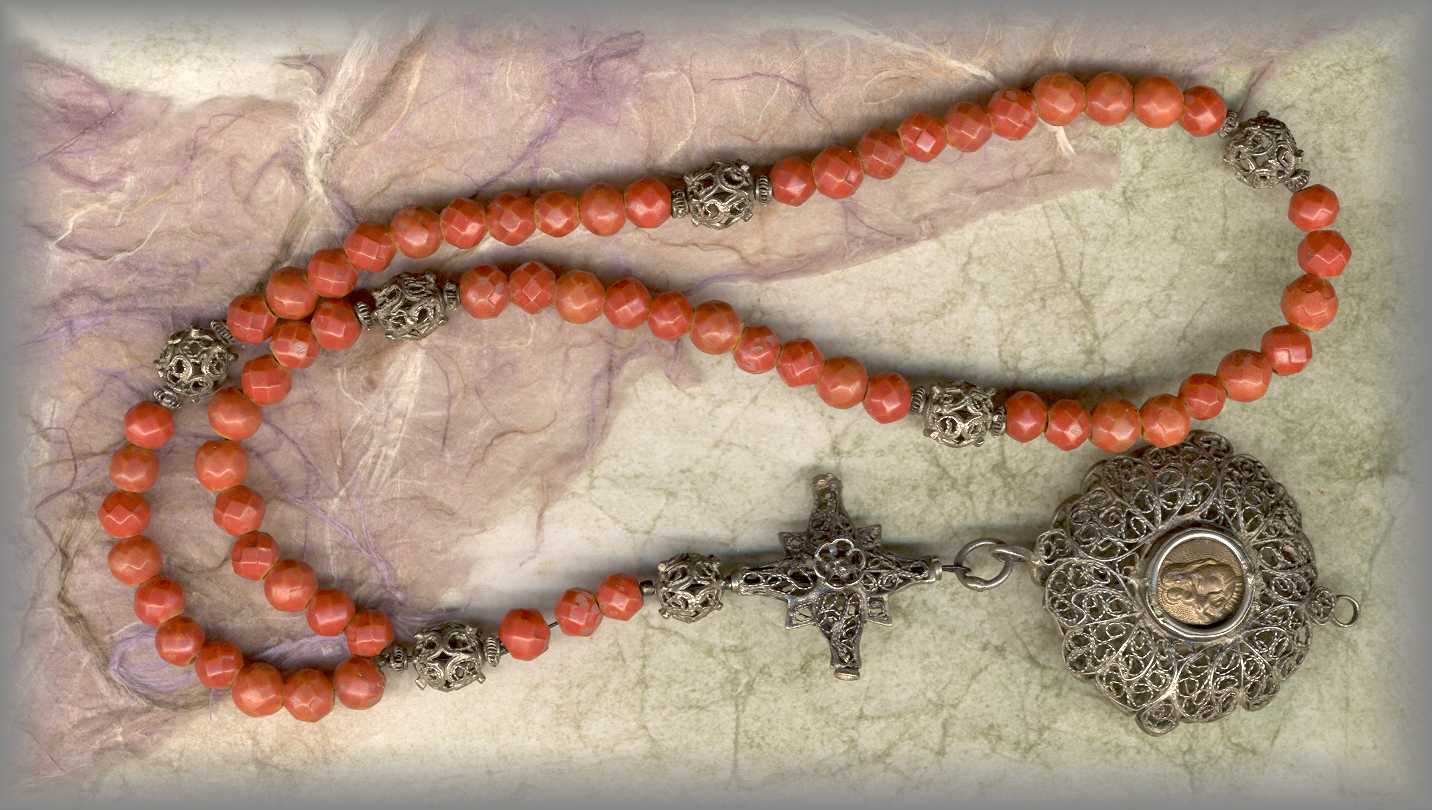
13.5 in long/7mm faceted coral pre 1850s |
|
(for more information, scroll down) + ENCOUNTERING THE FILIGREE HISTORY: OF FILIGREE ROSARIES In one display case there were three antique (strung) Rosaries, (similar to the ones shown above.) One had filigreed 'Pater Noster' beads with filigree boxes called 'reliquaries' (Relics of saints contained). DOMINICAN 'NUNNERY'
CONVENT
|
|
|
And I was hooked! These words and rosaries stayed in my mind all year. They were so different from anything I had ever seen before. They had to have a wonderful history. I said a little prayer for more information. Next year we went back to Germany and my first stop in Rothenberg was the museum. This is where doors began to open in ways I could not have imagined. Those sisters had a plan! And the Rosary Workshop was involved! Read how filigree
grew from 5000 BC to today.
|

*ANTIQUE BAVARIAN* |
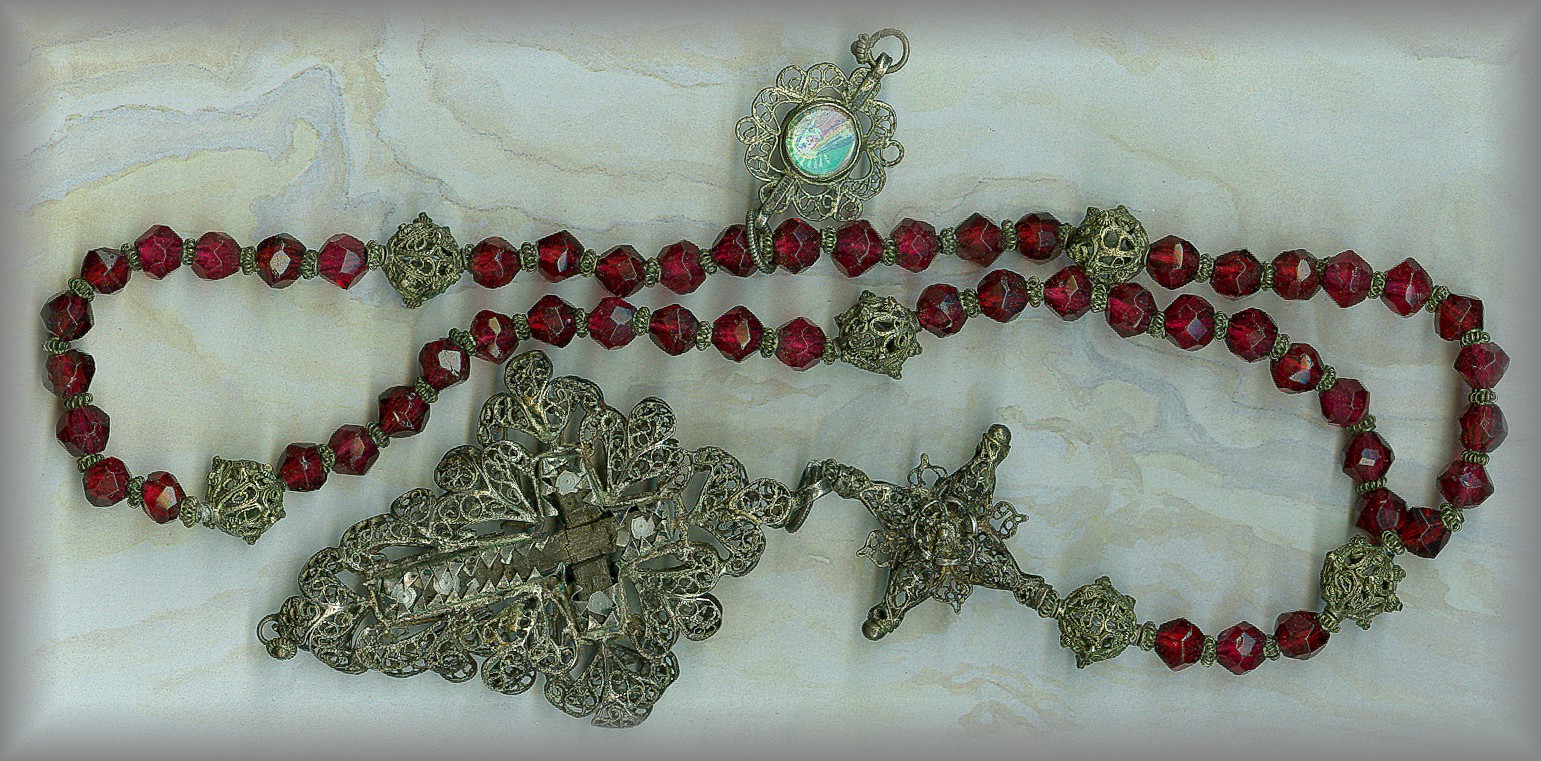
+ AVE BEADS: either glass or garnet ''Englush cuts" PATER BEADS: silver filigrees, also note 'small "Credo" cross and reliquary on pendant. + We drove past an antique shop specializing in antique furniture on Herrngasse, near the Franciscan Church earlier so it didn't look promising but something kept prodding me to walk the few blocks from the museum and check his windows. There they were - 4 old Rosaries. Two were filigreed. He offered all four for 2000DM but could only afford one, pictured above with clear red English cut 10 mm beads, it has five decades and had a round filigree box instead of a large cross below the small middle one. (We discovered the smaller crosss was called a 'Credo Cross' Dated 1850s and is 15 in long. + AUGSBURG AND MORE ROSARIES! In Augsburg we found a small religious goods shop on a corner of the main street of Maximilianstrausse 50. Visiting with the lady there who spoke some English she shared some wonderful history on our search. We understood her to say the family had been making religious art since late 11th century. We asked her about the configuration of different sets of decades. She explained that 7 decades represented the 7 Joys of Mary, (also known as the Franciscan Crown). She said she felt the other Rosaries had just lost their beads other than the standard 5 decade count. But later discovered the 6 decade rosary was called a Brigittine rosary. + She is also the one who identified the reliquaries as such. She said pilgrims collected the reliquaries from holy places, attaching them to their Rosaries to receive special blessings from the places they had visited. The walls were full of new filigree rosaries but we understand today, no one makes them any more. + Later the next day, We followed a lead to a shop down the stairs from Maximilianstrausse. I purchased a very interesting cross from 1880 and a Rosary that had beads set into the cross. A shop across the way had several Rosaries in the window, one was a filigree but they were closed that day. But it served it's purpose as it only made the hunt more interesting and planted the seed deeper. + The rest of the trip produced the standard antique Rosaries, medals and crosses. Some of which are very interesting and are a part of our collection for you. These were few and far between but worth the search.. Found one in Freiburg and another in Konstance (he said he had about 80 old rosaries at home but no filigree). Had there only been more time. And had I read more before the trip, would have realized we were in early rosary making centers! |
|
*ANTIQUE CORAL* |
|
TO HAVE SPECIAL PROPERTIES
+ AVE BEADS: Faceted corals (rare) PATER BEADS: silver filigrees along with "credo" cross and reloquary medallion on pendant. + Rare, faceted antique coral Aves with Filigree Paters. Coral was believed to have healing properties and was very popular as a rosary bead. (note the paintings of the early centuries.) This one I found in Rothenberg at an antique shop on one of the side streets. 6 decades - 13.5 in long with 7mm faceted coral beads - pre 1850s. |
|
*GARNET FILIGREE* . |
|
BACK IN THE US ? DC AREA
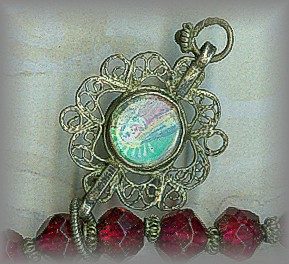
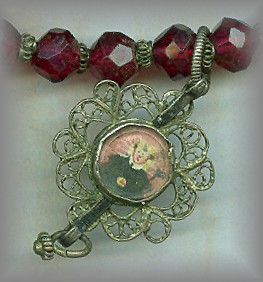
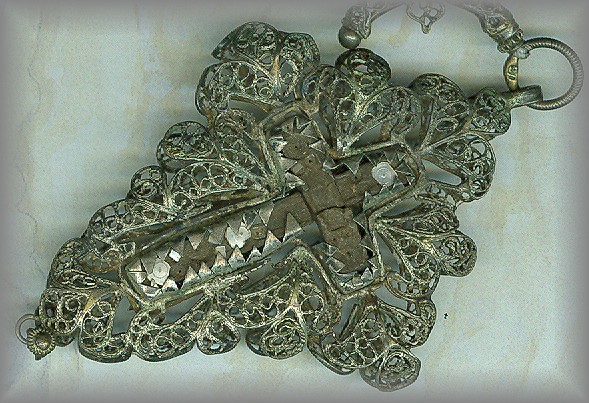
+ AVE BEADS: faceted garnets PATER BEADS: silver filigrees along with filigreed "reliquary" cross and "credo " cross. + When we came back to DC, we roamed around Old Town Alexandria VA looking for more old religious objects and didn't find much. Heading back up to my daughters office, I bumped into a small sign that said 'Antiques.' 'It didn't look like a place to find Rosaries', I thought, but went in anyway. + HAND PAINTED OUR LADY UNDER CRYSTAL
+ They brought out 3 of the most beautiful filigreed Rosaries I had seen yet. He dated the 3 from 1800-1840 and said they all came from one estate. They were made in Austria. He had papers on them and suspected they came from hierarchy in the Catholic Church. + FILIGREE CROSS
One, the smallest,
with small faceted red garnet beads (above) was a favorite. It had a very,
very old fragment of wood set with a bezel into the large silver filigreed
reliquary cross. (may have had a thin slice of MOP over surface as fragments
were still visible) He teased me with: 'It could be a fragment of the true
cross, you know'. I smiled and said, 'I wonder how large that cross was
to accommodate all the fragments claimed in the world today' (15 in.)
|
|
ABOUT THE ROSARY MAKERS While in New Mexico we did find out that the manufacturer of the museum Rosaries, Schwabisch Gmund, was the name of an area in lower Germany where precious metal jewelry was manufactured. + Looking back on the search, was delightfully amazed at how doors opened up along the way. How things got better after we found out that the German word for Rosaries is Rosenkranz. How we laughed at our feeble attempts to roll our tongue while trying to pronounce it! The people were patient with us, joining in on our German language lesson - and soon we learned the language became less and less of a barrier as we began to speak heart to heart. |
|
*HISTORY of FILIGREE* |
|
n. Filligree filigree: From the Latin ‘Filum’ (Thread), and ‘Granum’ (Seed). Fine, thread like wires of precious metals (gold and silver) are twisted and plaited (woven) to create highly ornamental lacy designs. Points of contact are soldered together with like metals to secure designs. The ancient soldering was accomplished by using flame and a blowpipe. Borax was used with the solder to complete the process. Its most familiar use is in jewelry but is also used other art forms. This includes, sacred book covers, church appointments, beads and reliquary crosses for filigree rosaries. |
|
ANCIENT ART FORM This exquisite, lacy metal technique is traced back before 5000 years. It is one of the oldest and most beautiful of art forms developed by man. It is totally hand crafted and requires hours of concentration. The closely guarded craft was passed from generation to generation, family member to family member. It may also be traced from the 6th to 3rd Century BC to the Etruscans who were also known for their granular work. Granular work, filigree and repouss? were known in the island of Crete by 2000BC. + INFLUENCE OF PHOENICIANS AND ETRUSCANS The Phoenicians were know for trading gold and silver throughout the Mediterranean Sea and also traveled to India dating back as far as 1000 bc. They also spread their filigree techniques. Many settled in southern Italy integrating with the Etruscans, a civilization of the 7th century bc dedicated to the arts. The Etruscan artists fused traditional geometric designs with the Phoenician's oriental influences of floral and figurative designs, refining Filigree to such an extraordinary degree that to this day their designs and techniques are still used by modern jewelers. + GREEK / ROMAN INFLUENCE Greek Filigree began to influence designs from about 323 bc from Europe to India. Filigree earrings, tassels and flowers were very popular. When Alexander the Great brought his bounty of gold and silver in from the Phoenicians, Egyptians and Persians, filigree began to grow not only to set stones, but in other ornamental uses. By 133 ad after Rome had taken over the Greek Empire, the Roman craftsmen combined precious stones with simpler settings and filigree again, went out of fashion. |
|
BYZANTINE / CHRISTIAN INFLUENCE During the 4th century invasion of the Goths, (Dark Ages) of the Roman Empire, filigree was lost and no longer passed down from generation to generation. But the Christian Byzantine Empire had become a ‘repository of classical learning, preserving the artistic heritage of the Greek and Roman artisans.’ Which meant that filigree was incorporated into monastic work such as covers to scripture and icons. These holy objects were often encrusted with precious stones, filigree, granulation and cloisonn? (enamel work), all of which worked well together creating an elegant style. + CELTIC KNOTS During the 10th to 12th century this metalwork found a new direction in the hands of the Irish. The Celtic knot work and weaving so typical of Irish designs seen in stone crosses and architecture were created in metal by using a continuous, unbroken metal thread that wove itself throughout the whole design. This technique was created by the Celtics and reflected their traditional knot-work designs beautifully + RENAISSANCE The Italian Renaissance (rebirth) of the 15th - 16th c found craftsmen and artists bringing back the beauty of ancient Greece and Rome and not only did this speak through personal adornment but in the eventual use of filigree beads and crosses in rosaries. By the end of the 16th century, Venice saw a revival of fine gold filigree beads, and semi precious stones were more often seen with filigree caps. During the Spanish Inquisition the Jewish gold and silversmiths settled in North Africa and introduced filigree and cloisonn? techniques to the craftsmen of the period. + Once filigree beads were discovered by rosary makers of that period, Paternoster guilds were formed in Schwabish Gmund (Bavaria) and Austria to fulfill the growing demands. (Families also began to make these rosaries, passing down their craft from one generation to the next.) Filigree beads and reliquary crosses with enamel work inserts grew in popularity, especially with the royalty and wealthy who began to wear them around their necks. + By the Middle Ages, the Moors (Spain) had refined filigree. From there it migrated to New Spain (Latin America), probably through the exploration of the new world where indigenous craftsmen duplicated the techniques. By the 18c, filigree styles not only reflected the Mayan, Aztec and Mixtec designs, it also kept the Spanish influence, creating a mix of ancient and contemporary that lives today. + INFLUENCES OF THE INDUSTRIAL REVOLUTION The Industrial Revolution of the 17th to the 18th century brought mass production but this did not affect the making of filigree as it was a hand made art form and craft. But the period did introduce other less expensive metals and materials for adornment such as brass instead of gold to make reproduction jewelry more available to the public. + EDWARDIAN / ART NUEVO 19c INTO THE 20c Faberge, a master jeweler of the 19th century revived the use of gold Filigree and during this period Filigree again became very popular during the Edwardian period (late 1800s). Clothing and jewelry moved into a beautiful new period called Art Nouveau. The fashionable passementerie (laces and trims) could now be copied in fine metal wires for jewelry. This ornamental work is also reflected in the work of Tiffany. By now, filigree rosaries have a history of several hundred years. Filigree rosaries in the traditional style still flourished through most of the 20th c but are rare and hard to find today. + On a recent (2007) visit to Oberammergau (Bavaria) we saw beautifully reproduced new ones that ran about $350 Euros. When asked about them, (as was told they were not being made any more by our Augsburg contact) we were told they are still being made in the Bavarian Forest of Germany. Regardless of availability, they are now a part of a glorious history. |
|
INFORMATION ON OLD ROSARIES? We continue to collect information on antique rosaries. If you have information you believe would be of value to those interested, please email images, dates, origin and any history you may have on your rosary. Click below: SHARE INFORMATION be sure and visit
these links
|
|
MISSION STATEMENT Our vision is to provide the finest handmade rosaries, chaplets and other fine religious art forms for personal worship we can make using the finest supplies available. The Guild believes the work of our hands should give visual Glory to God, therefore for us, the best for you is very, very important. +++
MUSEUM
- HISTORY
- PRAYER
PRAY
THE ONLINE ROSARY NOW
OFFICE
HOURS
|
|
secure-online - credit card -[or]- mail in - mo/personal check |