| MUSEUM
Antique Rosaries |
HISTORY
of the Rosary |
for you index |
cord instructions |
LINKS |
EMAIL
US+
877 695 3561 |
|
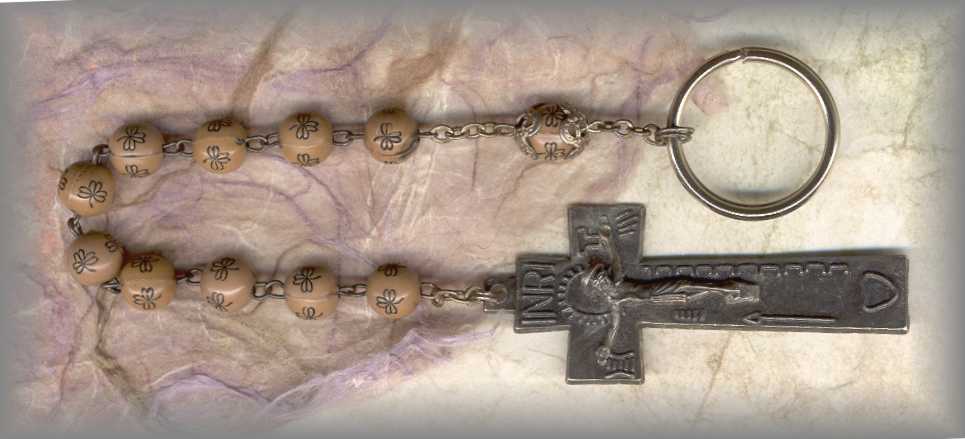
+ THE PERSECUTED CHURCH HISTORY: IRISH PENAL CHAPLET THE UNDERGROUND CHAPLET When the church was being persecuted the faithful went underground and the Irish Penal Rosary became popular. It could easily be hidden in the hand and up the sleeve. The ring was moved from one finger at a time (beginning with the thumb). In this process all 5 decades of the rosary were completed.
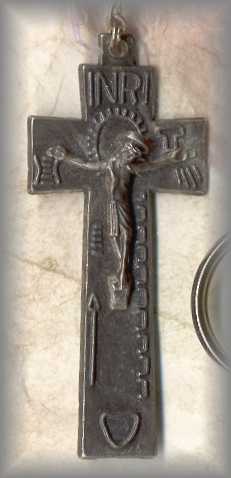
+ PENAL CROSS The long cross was believed to be designed to go into the hand more secretly - but some recent information from the National Museum of Ireland, home of the largest collection of Penal crosses tells us that these little crosses, carved from wood, were souvenirs from Loch Derg, (St Patricks Purgatory a holy site) Possibly the shape came from the Tall or High Crosses found all over Ireland symbolize the reaching up to heaven and dating back to the days of St Patrick (4th c). The other thought was that the longer horizontal arms broke off so they were shortened. We like the Tall or High cross theory better! for more information
|


*CONFIGURATION* |
|
'THUMB' RING AND CRUCIFIX
+ DATES BACK TO BEFORE 1500's Actually, this design with 10 beads and the ring at one end is a very old tradition dating before the 1500s. It is also called a 'Zehner' (Germany) or a 'Tenner' (England). The ring is moved 5 times, from one finger to the next to count off 10 sets of prayers on each which completed the 5 decades of the rosary. + POPULAR WITH MEN One decade chaplets (10 Aves & 1 Pater) Were especially popular with men. It was also convenient to slip up ones sleeve if necessary to conceal ones stand as a Catholic with its short arms. See more under Penal Crucifixes below - 9 in |
|
*BEADS*
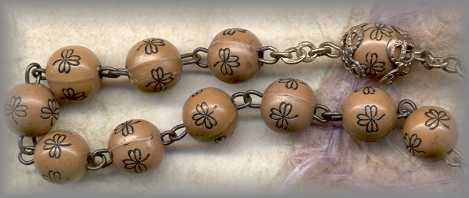
+ SOUVENIR CHAPLET Little clovers are carved into the surface of each coffee colored bead. A souvenir version of the traditional Penal rosary from before the 1700s |
|
*THE PENAL CRUCIFIX* |
|
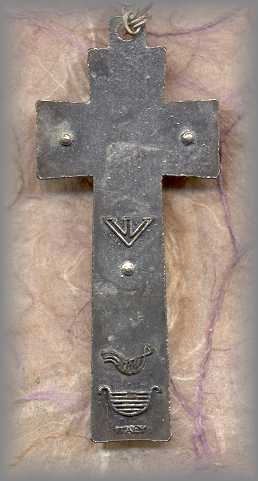
+ A modern day crucifix full of symbols on both sides tells the salvation story - 2.25 in
+ OBVERSE HAMMER: For the nails of the Cross HALO: Crown of Thorns was not usually shown JUG or CHALICE: The Last Supper CORDS for BINDING: Symbolize the Scourging at the Pillar SPEAR: Piercing the side of Jesus + REVERSE CROCK and POT: Symbolizing the early apocryphal legend relating to Judas the betrayer. Also the resting cock which suddenly came to life and crowed, thus prophesizing the resurrection. THREE NAILS: Tools of the Crucifixion + Thank you to all who have sent information ... Especially to Marianne Payne (Canada) + ... and to Fr Jim who wrote: On the Irish Penal rosary I believe you were wondering what the marks are on the right side. They symbolize a ladder. The cross being the ladder by which we reach heaven. Glad to be of help. Thanks for this information, Fr Jim! |
|
*HISTORY* |
|
Religious persecution in Ireland began under Henry VIII. (1540 till about 1731) The local Parliament adopted acts establishing the king's ecclesiastical supremacy, abolishing the pope's jurisdiction, and suppressing religious houses. A trip through the countryside of Ireland today will yield ruins of monasteries and churches everywhere. After awhile, one has to ask, what really happened? It is a long and sad history as soon after this came the Potato Famine which claimed the lives of hundreds of thousands of men, women and children. + PENAL TIMES In 1691, King James II signed the Treaty of Limerick. This assured that the Irish Catholics were secure to own their own land, could speak their own language and above all, practice their religion. History tells us that as soon as he left Ireland, the treaty was broken and all the guarantees above were denied by the English. + Death became the common penalty for attending or celebrating the Mass. Many many Priest and Laity lost their lives in the underground churches. These times became known as the 'Penal Times' and the Irish Penal Rosary became popular. |
|
MISSION STATEMENT Our vision is to provide the finest handmade rosaries, chaplets and other fine religious art forms for personal worship we can make using the finest supplies available. The Guild believes the work of our hands should give visual Glory to God, therefore for us, the best for you is very, very important. +++
MUSEUM
- HISTORY
- PRAYER
PRAY
THE ONLINE ROSARY NOW
OFFICE
HOURS
|
|
secure-online - credit card -[or]- mail in - personal check or M.O. |